

Reviewed by SEO Strategists at Wise Advertisement
Last Updated: August 2026
Reading Time: 12 Minutes
You are putting in the work. You publish content, maybe you run ads, maybe you have been doing SEO for a while. And yet a competitor still shows up above you every time you search for your own keywords.
But why competitors rank higher on Google? It almost always comes down to a small set of gaps, and those gaps usually involve content, links, technical health, or how well your page matches what the searcher actually wants. Most sites are behind in more than one of these at the same time.
After looking at this pattern across many businesses and industries, the same handful of gaps explain almost every case of a competitor outranking someone. Below, we break each one down and tell you exactly what to check and how to outrank your competition on Google.
Why Do Competitors Rank Higher Than Me on Google?
Here are the real reasons a competitor beats you in search results, along with what actually helps close each gap.
Their Content Answers the Question Better than Yours
This is the most common reason a competitor outranks you, and it is also the easiest one to fix. Google’s whole job is to give people the best possible answer to whatever they typed in, so if your competitor’s page does that better than yours, they get the spot instead of you.
Better does not simply mean longer. It means:
- The page answers the exact question being searched rather than a general version of it.
- The page is broken into clear sections with headers and bullets so it is easy to scan.
- The page has been kept current instead of sitting untouched for years.
- The page backs up its claims with real examples or data rather than vague.
The Fix: Pull up the page that currently outranks you and read it honestly. If it truly answers the question better than yours, do not copy it. Go deeper and add what they left out.
They are Targeting Search Terms You are Not
You could be writing genuinely solid content and still lose ground because your competitor is showing up for searches you never thought to target in the first place. This is usually called a keyword gap, the difference between the terms they rank for and the terms you rank for. Every one of those gaps is real traffic going to them instead of you.
A proper look at this gap tends to reveal a few different patterns:
- Some keywords they rank for do not show up for your site at all, which represents missed opportunities you have left on the table.
- Other keywords show them sitting in the top five results while you are stuck on page two or three, and these are often the fastest wins to chase first.
- In some cases you are both writing about the same topic, but they picked a page format that matches what searchers actually want, such as a how-to guide instead of a plain product page.
The Fix: Run a keyword gap check using a tool like Semrush or Ahrefs, compare your domain against your top two or three competitors, filter for keywords where they rank in the top ten and you do not appear at all, and prioritize by search volume and business relevance.
They Have More, and Better, Backlinks
A backlink is just another way why your competitor outranking you on Google. Backlinks are another website linking to yours, and Google treats these like votes of confidence. More high-quality backlinks generally build more trust, and that trust tends to lift rankings across your entire site rather than just one page. If a competitor has spent years earning press coverage, building relationships, and getting listed on respected industry sites, they have built up an advantage that genuinely takes time to close.
The Fix: Check where their backlinks actually come from using a tool like Ahrefs or Semrush, and look for patterns such as industry directories, publications, or partner sites they consistently appear on. From there, build a plan to earn similar links through guest posts, digital PR outreach, or content good enough that other sites want to reference it on their own.
Their Site is Technically Healthier than Yours
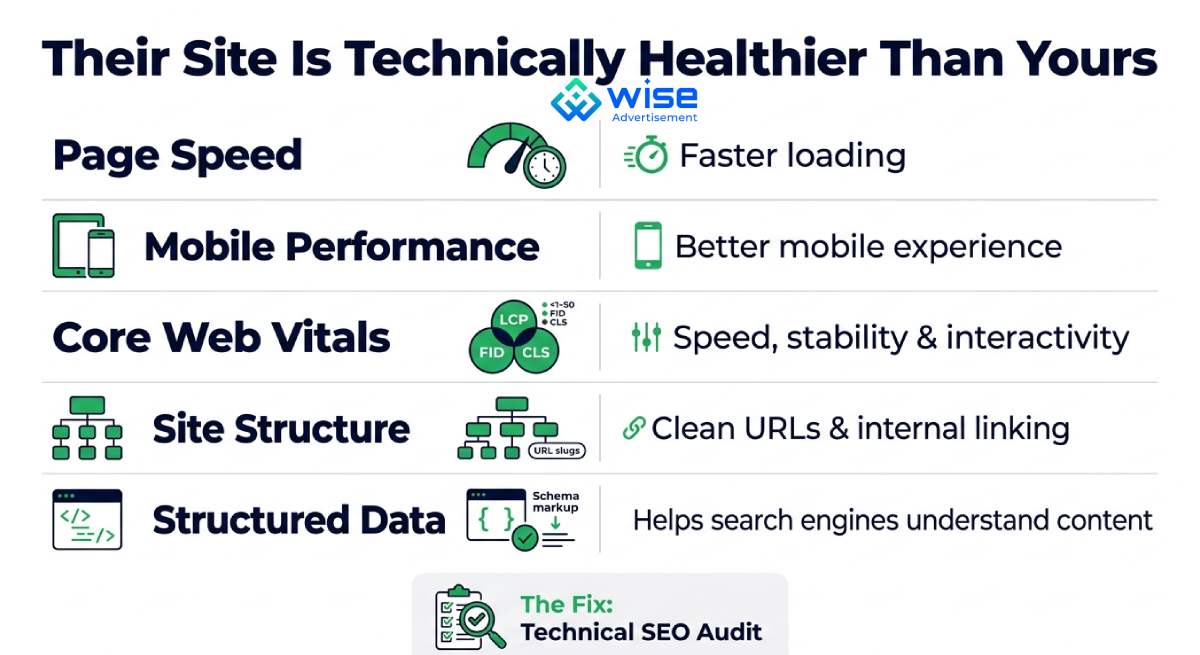
You can have great content and still ask yourself why competitors rank higher simply because their site runs better. A few things matter here at once:
| Technical factor | Why it matters |
| Page speed | A site that loads in under two seconds beats one that takes four or five, and even a one-second delay affects rankings and conversions. |
| Mobile performance | Google indexes the mobile version of your site first, so a rough mobile experience shows up directly in your rankings. |
| Core Web Vitals | These measure loading speed, visual stability, and interactivity, and competitors who score well here get a real edge. |
| Site structure | Clean URLs, sensible internal linking, and logical architecture make it easier for Google to crawl and understand your content. |
| Structured data | Schema markup helps Google and AI tools interpret your content accurately instead of guessing at it. |
The Fix: Run a technical audit through Google Search Console, PageSpeed Insights, or Screaming Frog. These issues are often invisible until you know where to look, which is why a full agency audit can catch things you’d otherwise miss.
They Have Built more Authority on the Topic
Google does not judge a single page on its own. It looks at your whole site to decide whether you count as a trusted, knowledgeable source on a topic. If a competitor has published forty solid articles on a subject while you have three, Google tends to see them as the authority, and that lifts every related page they have, including the ones competing against yours.
The Fix: Map out your core topics, find where the real gaps sit, and build a content calendar that steadily covers those topics instead of publishing in bursts. Depth and consistency beat volume almost every time.
They Look more Credible to Google
Google’s E-E-A-T guidance, which stands for experience, expertise, authority, and trust, makes it clear that showing who actually wrote your content matters. If a competitor features a named author with real credentials, cites solid outside sources, and shows actual case studies or measurable results, Google reads that as a trust signal.
The Fix:
- Add a real author byline that includes their role and relevant experience.
- Link out to credible outside sources whenever you make a factual claim.
- Show real results with actual numbers whenever you can.
- Add expert quotes where they genuinely fit the topic.
- Use Article schema so Google can connect your content to its author and your organization.
They Show up in AI Answers and You Do Not
This one is newer. Tools like ChatGPT, Claude, Google’s AI Overviews, and Microsoft Copilot now answer many questions directly, and they tend to pull from a fairly small pool of sources they already trust. If your competitor gets cited in those answers and you do not, they are picking up real visibility you are missing entirely, even if you still outrank them in the regular search results below.
But why competitors rank higher in AI search results? They might be creating content that is:
- Clearly structured and factual.
- Written by a credible, identifiable source.
- Backed by consistent brand signals across the web.
- Free of technical barriers that would block crawling or indexing.
The Fix: Check how AI tools currently describe or cite your brand compared with your competitor, clean up your content structure so machines can read it easily, and build the kind of consistent authority signals that make AI tools more likely to pick your content over theirs.
They Keep Their Content Updated
SEO is not something you finish once and walk away from. A competitor who regularly refreshes older articles with new data, current examples, and up-to-date information tends to hold their rankings far longer than one who publishes something once and never touches it again.
The Fix: Set a recurring schedule to revisit your best performing pages every few months, update outdated stats, and add anything newly relevant.
They Get More Clicks from the Search Results Themselves
Even a well-built page can underperform if its title and description do not match what people are actually searching for. Google tracks how often a result gets clicked and whether people stick around afterward, and a title that speaks directly to the searcher’s real question earns more clicks than one that reads as vague or generic.
The Fix: Rewrite your title tags and meta descriptions to match the exact intent behind a search, not just the keyword itself.
How to Check Which Gap Applies to Your Site
You don’t need expensive tools to start figuring this out yourself:
- Search your own keyword in an incognito window and open both pages side by side.
- Look at the topics each page actually covers, not just word count, and see if their page answers something yours leaves out.
- Check your Google Business Profile completeness and review count against theirs, if that applies to you.
- Run both URLs through a free page speed checker and compare mobile load times.
- Search your business name next to theirs and see who picks up more press mentions or backlinks.
These steps point you in a direction, but every situation is a little different, and the only way to know for sure is to actually dig into the data on both sites.
A full competitive SEO analysis usually covers the entire keyword gap between your site and your competitor’s, the backlinks pointing to each site, the technical health of both, how deep each site’s content actually goes, and how visible each of you currently is inside AI search results. That kind of analysis answers the more useful question, which is how to outrank them in a way that fits your specific business and market, not a one-size-fits-all checklist.
If you want a deeper look at how gaps like these get fixed in practice, our search engine optimization page walks through our process.
Why Competitors Rank Higher on Google’s Local Searches
If your business depends on people nearby actually finding you, like a local shop, a clinic, or a service provider covering a specific area, a few extra factors come into play that content and backlinks alone will not fix.
Proximity to the Person Searching
Google factors in the searcher’s actual location when deciding who to show in local results, and two businesses can have equally strong websites while the one physically closer to the searcher still gets the edge, especially in map results.
How Complete Your Google Business Profile is
A profile with accurate hours, the right categories, real photos, and a full description tends to perform better than one left mostly blank. A quick self-check:
- Confirm your business categories match what customers actually search for.
- Add recent photos instead of leaving old or default ones in place.
- Fill in your business description completely rather than leaving it generic.
- Post updates regularly instead of letting the profile sit untouched.
How Many Reviews You Have and How You Respond
This isn’t just about collecting more reviews than everyone else. Recent reviews carry more weight than older ones, and responding to reviews, good or bad, signals that a business is active and engaged. A competitor with fewer total reviews but more recent, responded-to ones can still beat you here.
How Consistent Your Business Information Is
Your business name, address, and phone number need to match exactly across every directory, review site, and page on your own website. Inconsistent listings confuse Google about which business is legitimate, and that confusion weakens trust in local results.
Whether Your Content Speaks to the Locals
Generic content that could apply to any city rarely performs as well locally as content that mentions specific neighborhoods, local landmarks, or concerns unique to that area.
How Much Engagement Your Listing Gets
Google also watches how often people click through, call, or ask for directions from your listing. A competitor who generates more of these actions is telling Google they’re relevant, and that reinforces their position over time.
How Long Does It Take to Close the Gap?
There is no single number that applies to every situation, but a realistic, phased timeline tends to look something like the following.
These ranges are directional rather than guaranteed, since what your competitor does next, any algorithm changes that occur, and the original size of the gap all affect the actual timeline you experience.
If you’d rather get visibility while the organic fixes take hold, paid advertising can fill that gap in the meantime.
Common Mistakes Businesses Make Chasing a Competitor’s Ranking
You want to know how to outrank a competitor? Stop:
- Copying a competitor’s page structure without checking if it actually matches what the searcher wants.
- Buying backlinks or joining link schemes, which Google actively penalizes once discovered.
- Publishing more content without fixing a technical problem sitting underneath it.
- Ignoring Google Business Profile and reviews while focusing only on the website.
- Giving up after a few weeks, before technical and content fixes have had time to show movement.
Outrank Your Competitors on Google in Phoenix
If you have made it this far, you know closing a ranking gap takes more than one fix. It takes the right mix of content, technical work, backlinks, and local signals, applied in the right order.
That is exactly what we do at Wise Advertisement. We are a digital marketing company based in Scottsdale, and we work with businesses across the greater Phoenix area who are tired of watching a competitor outrank them for the keywords that actually bring in customers.
Our Phoenix digital marketing company services include:
- Search engine optimization
- Website design and development
- Paid advertising
- Social media marketing
- Email marketing
- Motion graphics and video production
We do not start with a generic package. We look at your site next to the competitors actually beating you, so we know which gaps to close first and which ones will move the needle fastest.
Ready to find out why competitors rank higher on Google? Call us at +1 (480) 908-6800 or visit us at 15169 N. Scottsdale Rd, Suite 205, Scottsdale, AZ 85254.
FAQs
Why is a smaller or newer competitor outranking my established business?
Age alone does not guarantee a top spot. A newer competitor can outrank you by covering a topic more thoroughly, running a faster site, or targeting a keyword gap you never noticed.
Can a competitor outrank me even if my website looks better?
Yes. Design and rankings are not the same thing. Google cares about whether the content answers the question, how the site performs technically, and how much trust it has built, not how polished it looks.
Why is a competitor ranking higher on Google Maps even if I have better reviews?
Local rankings weigh more than star rating alone. Proximity, Google Business Profile completeness, review recency, and listing consistency all factor in too.
Does paying for ads help me outrank a competitor organically?
No. Paid ads and organic rankings run through separate systems. Ads can get you visibility while you work on organic fixes, but they do not improve your position in the regular search results.
How often should I recheck why a competitor is outranking me?
Every few months is reasonable, since content, backlinks, and technical health shift over time on both sides.
What keywords are my competitors ranking for?
A keyword gap analysis using a tool like Ahrefs or Semrush will show you which terms they rank for that you currently do not.
What’s the most important factor for beating competitors in local search?
There’s rarely one single factor. A complete Google Business Profile, consistent recent reviews, and accurate business information tend to matter most together.