

SEO and GEO are not the same thing, but they are not enemies either. SEO helps your website show up in regular search results. GEO helps your business get mentioned inside AI-generated answers, like Google’s AI Overviews, ChatGPT, or Perplexity.
In short, GEO vs SEO comes down to this: SEO gets you found in search results. GEO gets you mentioned inside AI answers. GEO does not replace SEO. It builds on it. If you already invest in SEO, most of that work still helps you with GEO too.
This guide breaks down the real difference between SEO and GEO, how each one actually works, and what it means for your business, in plain, simple words.
What Is SEO
SEO stands for search engine optimization. It is the ongoing work of helping your website rank higher in normal search results, the blue links you see on Google. It involves your site’s content, structure, loading speed, and the links other sites point to you.
How SEO Works
SEO works in three basic steps.
- Crawling: Search engines send out programs that scan your website and read what is on it.
- Indexing: What they find gets stored and sorted into a massive database.
- Ranking: When someone searches, your page gets placed in order against every other page, based on signals like keywords, backlinks, site structure, and how fast your page loads.
The results stay fairly steady. If you search the same thing today and tomorrow, you will likely see close to the same list.
What Actually Improves SEO Rankings?
SEO today is about more than keywords. It’s a mix of good content, a well-built site, and real trust from other websites.
- Keyword Optimization: Using the words your customers actually search for in your titles, your main heading, and throughout your content.
- Content Quality: Writing helpful, original content that answers the questions people are really asking.
- Technical SEO: Keeping your site fast, easy to use on a phone, and set up with structured data, often called schema markup, so search engines can read it clearly.
- Link Building: Earning links from other trusted websites. Real backlinks still signal that your site can be trusted.
- User Experience: Making your content easy to read, easy to navigate, and easy to stay on. A clean, simple experience keeps people around, and that helps your rankings too.
What Is GEO?
GEO stands for generative engine optimization. It is the work of helping AI tools, like Google’s AI Overviews, ChatGPT, Perplexity, Copilot, and Gemini, mention or cite your business when someone asks a question.
There is also a related term called AEO, or answer engine optimization. AEO focuses on getting picked for direct, structured answers, like voice search results or featured snippets. It overlaps with GEO, but it is not the same thing. This guide focuses on the difference between SEO and GEO specifically.
How GEO Works
GEO works differently. AI tools like ChatGPT, Claude, Gemini, and Google’s AI Overviews use a process called retrieval-augmented generation, or RAG. In plain words, this means the AI pulls information from several sources, picks out clear facts and statements, and writes a new answer using them, often listing where the information came from.
This is different from how a search engine crawler behaves. A search engine crawler tries to map your whole website. An AI crawler is more selective. It skips clever wordplay and brand storytelling and looks for plain, factual statements it can lift out cleanly (xfunnel.ai).
What Makes Content GEO-Friendly?
Good GEO content is easy to trust and easy to pull from. A few habits make the biggest difference.
- Put your answer near the very top, within the first few sentences, instead of making the reader dig for it.
- Write for meaning, not just for keywords. AI tools look at what a sentence actually says, not just which words it contains.
- Back up your claims with real numbers, expert quotes, or trusted sources.
- Keep your content current. AI tools tend to favor pages that have been updated recently.
- Use the same business name and description everywhere. Mixed or inconsistent naming makes it harder for AI tools to connect the dots.
- Show real experience, expertise, authority, and trust, often shortened to E-E-A-T. This still matters as much for GEO as it does for regular SEO.
Where Does GEO Content Show Up?
GEO-friendly content can appear in several places, including:
- Google’s AI Overviews
- ChatGPT and Claude
- Perplexity, which usually lists its sources
- Copilot and Gemini summaries
Many of these are zero-click spaces. That means someone can get a full answer without ever clicking through to a website.
Why Does GEO Matter Right Now?
Search behavior is shifting. More people read a summarized answer instead of clicking through a list of links, and that trend is only growing.
This changes what “visibility” means. Showing up now depends on being cited inside an answer, not just ranking on a page. That’s why GEO matters: it protects your visibility as more people search this way, and keeps your brand part of the conversation even when no one clicks through.
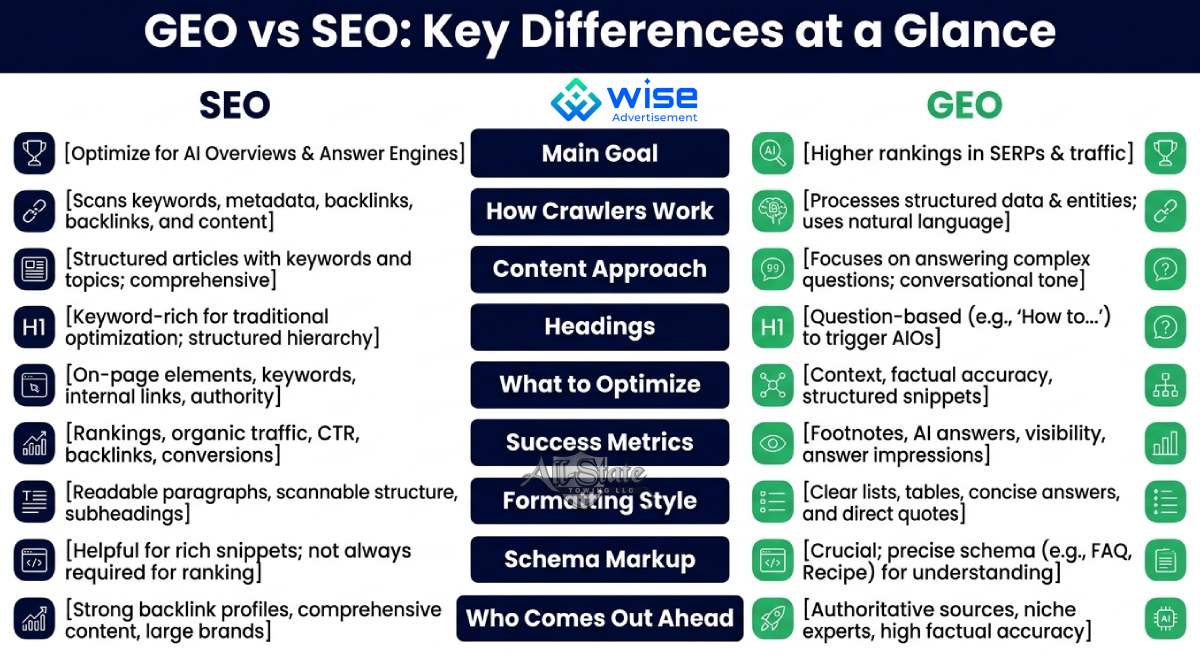
GEO vs SEO: The Key Differences at a Glance
Looking at SEO vs GEO side by side makes the difference easier to see. It also helps to compare them from a few angles: what each one optimizes for, how results show up, and what actually counts as success.
| What it looks at | SEO | GEO |
| Main goal | Rank high enough in search results that people click through to your site | Get picked as a source inside an AI-generated answer |
| How crawlers work | Search crawlers try to read and map your whole site, every page and every link | AI crawlers are choosier. They pull out specific facts they can use to answer a question |
| Content approach | Keep people on your site, build authority across several pages, and earn links from other sites | Give a clear, direct answer that’s easy for an AI tool to lift and quote |
| Headings | Built mainly around keywords and easy navigation | Written to act like a clear outline an AI tool can follow |
| What to optimize | Meta tags, site structure, page speed, and internal links | Direct statements, close word pairing near your brand name, and structured formats like FAQs and tables |
| How success is measured | Rankings, click-through rates, and organic traffic, all with well established tools | Mentions and citations inside AI answers, plus brand searches, though the tools for this are still catching up |
| Formatting style | Room for creative headlines, with information spread across several pages | Direct answers, related information kept together, little to no filler |
| Schema markup | Helps you win rich snippets in search results | The exact same markup also helps AI tools understand what your content is and how it’s organized |
| Who comes out ahead | Sites with strong authority, solid backlinks, and clean technical SEO | Sites that give the clearest, most direct answer to the question being asked |
This is also where geo seo confusion often comes from. GEO is sometimes shortened the same way local, geography-based SEO work is described. In this guide, GEO always means generative engine optimization, not location targeting.
Should You Forget About Keywords When Optimizing for AI?
No, keywords still matter. When someone asks an AI tool a question, the system often breaks that question into several smaller, related questions before it builds an answer. Those smaller questions usually sound a lot like normal search terms.
So the real shift isn’t dropping keywords. It’s widening them. Instead of chasing one exact phrase, think about every question a real customer might ask, in their own words, and make sure your content answers those questions directly.
Do Web Crawlers and AI Crawlers Work in the Same Way?
Not quite. A regular web crawler tries to read and map your entire site, page by page. An AI crawler is choosier. It skips clever wording and brand storytelling, and looks for plain, factual statements it can lift out and quote.
That’s really the heart of GEO vs SEO. One kind of crawler is building a full index of your site. The other is hunting for specific, well-stated facts it can cite in an answer.
Why is Heading Structure Important for GEO?
AI tools don’t skim the way a person does. A human can glance at a page and figure out what matters from context alone. An AI tool leans almost entirely on your headings to do that job for it, using your H1, H2s, and H3s like a map of what the page covers and how the pieces connect.
Regular SEO mostly cares about headings for keywords and easy navigation. GEO asks a bit more of them. Your headings also need to give an AI tool enough context to understand each section and quote it correctly.
That’s why specific headings beat generic ones every time. “Learn More” tells an AI system nothing useful. “How Schema Markup Helps AI Understand Your Content” tells it exactly what’s there.
How AI Crawlers Actually Read Your Headings
Think of your heading structure as an outline, because that’s exactly how an AI tool treats it. A clear, specific heading lets it know precisely what a section is about before it even reads the content underneath.
This is also where a “clever” heading can backfire. A section called something playful and vague won’t tell an AI tool what’s actually there, even if it reads well to a person. A heading that plainly states the topic leaves no guesswork.
How to Get Your Heading Hierarchy Right
A clean, consistent heading structure helps AI tools pull accurate information and makes your content more likely to get cited.
Stick to one H1 per page, placed first, and make it descriptive enough to sum up the whole page. Use H2s for your main sections, and H3s to break those sections into smaller, easier-to-digest pieces.
This trips up more sites than you’d expect. A common mistake is using multiple H1s just because a design team likes the larger font, or using heading tags for things like site navigation or a “back to top” link. None of that is really a heading, and it leaves an AI tool guessing at what your page is actually about.
Does GEO Replace SEO?
No. GEO does not replace SEO. AI tools still rely on well-built, well-structured, trustworthy content to find things worth citing. Google’s own guidance states that its AI features are meant to work alongside regular search results, not instead of them (Google). If your SEO is solid, that work is not wasted. It is the foundation GEO builds on.
Where SEO and GEO Overlap (and Why That’s the Good News)
SEO and GEO share more than people expect:
- Both reward experience, expertise, authority, and trust, often called E-E-A-T. Original, well-researched content performs well in both.
- Schema markup helps both at the same time.
- Brand authority, built through backlinks, mentions, and media coverage, strengthens visibility in both places (Evertune).
The good news: most existing SEO work already supports GEO. You are not starting from zero. Learn more about how E-E-A-T supports SEO search rankings in our related guide.
Why Structured Formats Work So Well for SEO and GEO
Search engines and AI tools both favor the same formats: FAQs, quick summaries, numbered steps, and comparison tables. These make information easy to spot and pull out. For search engines, that can mean a featured snippet. For AI tools, it means your content is already shaped like a ready-made answer.
FAQs
FAQs have always helped SEO, but for GEO they matter even more, since they often match the exact question someone asks an AI tool. If your page already answers “what does this service include,” an AI system can find and use that answer directly.
Quick Summaries
Whether you call it a summary or a key takeaway, this short recap is one AI tools pull from often, since it hands over the core point without any digging.
Step by Step Instructions
Many people ask AI tools how to do things. A simple, numbered guide is easy to write and easy for an AI tool to lift when someone wants exactly that kind of answer.
Comparison Tables and Pros and Cons Lists
A clean table shows an AI tool how options relate to each other, instead of making it piece that together from paragraphs of text.
Schema Markup Ties It All Together
Schema markup is the behind-the-scenes code that labels your content clearly, marking a question, a review score, or a product, without the reader ever seeing it (ClickPoint Software). For SEO, it can earn a rich snippet. For GEO, it does double duty: add it once, and it helps in both places, since AI tools read schema too.
How to Actually Pursue Both GEO and SEO
You do not need two separate strategies. A few simple habits cover both at once.
- Ask ChatGPT and Perplexity directly what they currently say about your business. This is a fast, free way to see where you stand today.
- Keep your business details current: services offered, service area, hours, and general pricing.
- Build your presence beyond your own website, through reviews, local press, directory listings, and a complete Google Business Profile.
- Write content that answers real customer questions directly, in plain words, instead of writing only around keywords.
- Track your AI visibility on its own, not folded into your regular SEO reports. Ask ChatGPT and Perplexity the same question every so often and note whether your business shows up, since that’s a different kind of signal than a keyword ranking.
- Widen your presence past reviews and directories: guest posts on other sites, podcast appearances, and any press mentions all feed the same brand-authority signal that AI tools draw on.
How to Write Content for GEO and AI Answers Specifically
GEO is still a young, changing field, but a few writing habits already seem to help: question-style headings, plain factual statements, and keeping the right words close to your brand name.
Why Question-Style Headings Help
Questions mirror the way people actually type into AI tools, so turning a heading into a question can genuinely help your content get picked up. The key is answering it plainly in the sentence right after it, not easing into it with a vague lead-in.
Not every heading needs to be a question. A “how to” heading, a numbered heading, or one that simply states a clear benefit can work just as well. Use whichever fits the section, and answer it directly either way.
Stating Facts Plainly
AI tools are constantly scanning for plain, factual statements, the kind built from a simple pattern: who or what, did what, to what. A sentence like “Wise Advertisement builds websites for local businesses across Phoenix” gives an AI tool something solid to work with. A sentence buried in vague marketing language doesn’t.
This doesn’t mean writing like a robot. It means making sure the real information in your writing is easy to spot and easy to lift out, instead of getting lost in flowery phrasing.
Keeping Key Words Close to Your Brand Name
This one is still an emerging idea in GEO, but it’s worth knowing. AI tools learn patterns from the text they’re trained on, including which words tend to sit near each other. Some early thinking suggests that keeping a strong, simple word close to your brand name, rather than several sentences or clauses away, may help build a clearer association over time.
What This Means for a Small or Local Business
If you run a small or local business, here is the short version. You do not need a separate GEO budget or a brand new strategy. Most of what makes a website good for SEO; clear writing, accurate information, and a well-organized site; already supports GEO too.
Learn more about how AI tools read and index your website in our guide on how AI enhances crawling and indexing.
Common Mistakes to Watch For
A few mistakes show up often.
- Treating GEO as a total replacement for SEO, instead of an extension of it.
- Chasing keyword density instead of writing direct, specific answers.
- Ignoring how your business already appears across the web, in reviews, directories, and social profiles, since AI tools draw on all of it.
- Trusting any promise that guarantees a spot inside an AI answer. No one can guarantee that right now, since AI ranking factors are still changing and not fully public, including from us.
SEO and GEO: Quick Recap
SEO gets your site found in search results. GEO gets your business mentioned inside AI-generated answers. One builds on the other, so nothing here means starting over, it just means one more place your business needs to show up.
Ready to make sure your website is working for both? Wise Advertisement builds SEO and content strategies that hold up in traditional search and AI-generated answers alike. Contact our SEO team today for a straightforward look at where your business stands, and a clear plan to get you found, wherever people are searching.
FAQs
Will GEO replace SEO?
No reputable source suggests GEO replaces SEO. AI tools still rely heavily on well-optimized, well-structured content, so the two work together rather than compete.
Is SEO no longer relevant?
SEO is still relevant. Most of what makes content easy for AI tools to reference; clarity, structure, and credibility; is the same work good SEO has always required.
What is GEO in SEO?
GEO stands for generative engine optimization. It is the practice of helping AI tools mention or cite your content when they generate an answer, separate from traditional search ranking.
What is the main difference between SEO and GEO?
SEO optimizes for ranking in search engine results. GEO optimizes for being referenced inside an AI-generated answer.
What is AEO vs GEO vs SEO?
SEO focuses on search rankings. AEO focuses on structured question and answer visibility. GEO focuses on being cited inside AI-generated answers. They are related but not interchangeable.
How does an AI tool actually decide what to cite?
Most AI tools pull from several sources, extract clear factual statements, and favor content that states things directly instead of vaguely (Shanika W.).
How do I know if my business is showing up in AI search results?
Ask ChatGPT, Perplexity, or Google’s AI Overview a question a customer might ask, and see whether your business gets mentioned or cited.
Does my current SEO agency need to do anything different for GEO?
Most core SEO practices still apply. Content should also be structured to answer real customer questions directly, and your brand presence beyond your website, like reviews and directories, now matters just as much.