Reviewed by Digital Marketing Strategists at Wise Advertisement
Last Updated: August 2026
Reading Time: 8 Minutes
Most businesses don’t have the time or money to build a great website and a great social media presence at the same time. So something has to come first. So which one should you invest in first: Website vs Social Media?
For most businesses, that’s the website. It’s the one place online you actually own, and it’s the one thing all your other marketing eventually needs to point back to.
Below, we break down what each one actually gives you, when social media should come first instead, and how to decide what’s right for your specific business.
Website vs Social Media: The Differences
Before deciding which one to build first, it helps to understand how different these two things really are. They’re not two versions of the same tool. They work in completely different ways.
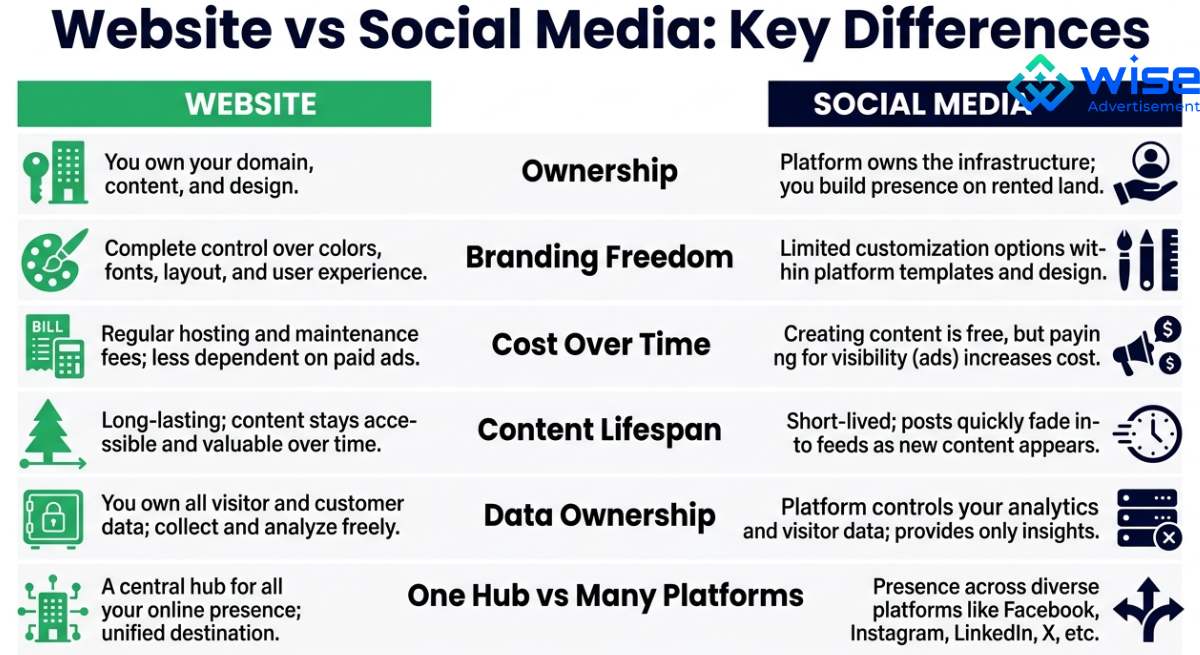
Ownership
When you build a website, you own it. You own your domain name as long as you keep renewing it, you decide the layout; and you control the content that goes live. Your website stays exactly as long as you keep paying for it and maintaining it; nobody else’s rules apply.
On social media, you’re renting space in someone else’s building. You can decorate your little corner, but the platform owns the building, and they can change the rules whenever they want.
Branding Freedom
A website is a blank canvas. You can design every part of it to match your brand, the colors, the fonts, how it feels to use, which builds a stronger, more consistent brand image over time.
Social media gives you some room to brand yourself too; your profile picture, your header, your posts. But you’re stuck inside whatever layout that platform allows.
Cost over Time
A website usually means a bigger upfront cost to build, then a fairly predictable ongoing cost for hosting and upkeep. Once it’s live, it keeps working without needing constant new spending.
Social media is free to join, but it costs your time instead of money, and if you want real reach beyond your existing followers, you’ll likely end up paying for ads anyway.
Content Lifespan
Website content tends to stick around. A blog post or page you publish today can keep bringing in visitors for years with a little upkeep.
Social media posts have a short shelf life. A post gets buried in the feed within a day or two, no matter how good it was.
Who Owns Your Data
A website gives you full access to your own visitor data: where people come from, what they click, how they move through your site.
Social media only gives you the data the platform decides to share, and you never get the full picture of who’s actually seeing your content.
One Hub vs Many Platforms
A website is a single, central place for your business online. You build it once, and everything else can point back to it.
Social media usually means keeping up a presence across several platforms at once, since your audience isn’t all in one place, which spreads your time and effort thinner.
What a Website Actually Gives You That Social Media Doesn’t
Here’s what a website adds that social media simply can’t replace:
- It builds trust. A professional website makes your business look legitimate and serious. Customers tend to trust brands with a real website more than ones that only exist on social media.
- It shows up on Google. A well-built website can appear in search results when someone is actively looking for what you offer. Social media just can’t compete with that kind of search visibility, and skipping a website means losing out on people who are already searching for you.
- It’s built to turn visitors into customers. A website can guide someone from just browsing to actually buying, using a clear path, a good landing page, and a strong call to action.
- It lets you build an audience you actually own. Through email sign-ups or gated content, you can collect a direct way to reach your customers. That list is yours. No algorithm change or policy update can take it away, unlike your social media followers, who technically belong to the platform.
- It doesn’t depend on anyone else’s rules. A website stays online and keeps working exactly the way you built it, regardless of what any social platform decides to change.
If you want to see what a website built to convert actually looks like, our website design and development page shows how we approach it.
What Social Media Actually Gives You That a Website Doesn’t
Social media isn’t the lesser option here. It’s just built for different things:
- It puts you in front of new people fast. Platforms like Facebook, Instagram, and LinkedIn have huge built-in audiences, and when people share your content, it can spread far beyond your own followers at little to no cost.
- It lets you talk to your audience in real time. You can respond to comments, messages, and reviews right away, which builds a real sense of community around your brand.
- It gives you instant feedback. You can see how people react to your content immediately and adjust what you’re doing based on that.
- It lets you jump on trends. Joining a viral moment can bring in a burst of attention fast, though it takes some agility to keep up with what’s happening.
- It sends people to your website. Social posts and ads are a great way to get interested people to click through and read a blog, check out a product, or fill out a form.
- It’s the fastest way to share news. Sales, events, launches, anything urgent, social media gets it in front of people immediately.
If you’d rather get in front of customers right away while your website or social presence grows, paid advertising can fill that gap in the meantime.
Can Social Media Replace a Website?
Social media does a lot of things well, but it can’t fully replace what a website does.
Customers often expect a real business to have a website where they can find complete information and a way to contact you. Without one, you risk looking less established than competitors who have a full online presence.
Social media also has real limits when it comes to telling your story. Posts and videos work for quick messages, but they don’t give you the space to explain a complex offer, walk through detailed features, or lay out your full brand message the way a website can.
Wise Advertising Experience: If something goes wrong with your account- a bug, a hack, a mistaken policy flag- getting it back isn’t always guaranteed. You could lose everything you built there with very little you can do about it.
When Should Social Media Come First?
Website first isn’t the right call for everyone, and it’s worth being honest about that.
- If you’re still testing a new product or business idea, social media is a cheaper, faster way to see if people are interested before you invest in a full website.
- If you’re building buzz ahead of a launch, social media can build an audience that’s ready to show up the moment you’re ready to sell.
- If your business genuinely sells through the platform itself- some creators and some local food or retail businesses fall into this category- social media might carry more weight early on than a website would.
The Real Risk of Social Media Without a Website
Your reach on social media isn’t guaranteed! An algorithm change can quietly cut how many of your own followers even see your posts, overnight, with no warning. Platform rules shift constantly too, and an account can get restricted or suspended without much of a way to appeal it.
And even with a huge following, those followers belong to the platform, not to you. They aren’t the same as customers you can reach directly whenever you want, through email or your own website. If the platform disappears or changes the rules, so does your connection to that audience.
Website vs Social Media: How to Decide for Your Specific Business
Ask yourself these questions:
- What’s your budget right now, enough for one, or enough for both?
- Do people search for what you offer, or do they mostly discover it by browsing?
- Is your business ready for a real launch, or are you still testing the idea?
- Can you actually keep up a consistent posting schedule, or would that content just sit unused?
Your answers will point you toward the right first move for your specific situation, not just a general rule.
Build a Website and Your Social Media Presence in Phoenix
If you’ve read this far, you already know that choosing between a website and social media comes down to your budget, your goals, and where your business stands today. Getting that call right from day one can save you months of wasted effort and spending.
That’s where Wise Advertisement comes in. Our Phoenix digital marketing company works with businesses throughout the Phoenix area, offering both affordable website design and social media management, so you’re not stuck choosing between two separate agencies.
We don’t hand out a one-size-fits-all package. We take a real look at your business, your goals, and your budget so we can tell you what to prioritize now and what can wait until later.
Want help skyrocketing your business? Call us at +1 (480) 908-6800 or stop by our office at 15169 N. Scottsdale Rd, Suite 205, Scottsdale, AZ 85254.
FAQs
Do I need a website if I have social media?
Yes, in most cases. Social media is great for reach and conversation, but it can’t replace the trust, search visibility, and ownership a website gives you.
Which should I invest in first, website or social media?
For most businesses, the website comes first, since it’s the one thing you own and the one place all your other marketing can point back to.
Can I run my business with just social media and no website?
It’s possible for some businesses, especially ones that sell directly through the platform, but you’ll be relying entirely on rules and algorithms you don’t control.
Should I build a website before starting social media, or at the same time?
Either can work. If you have the budget, building both together is ideal. If you have to choose, get the website live first so your social media has somewhere solid to send people.
Does having social media help my website show up on Google?
Not directly, but it can drive traffic and brand searches that support your overall visibility over time.
How much should a small business budget for a website versus social media?
This depends heavily on your industry and goals, but a basic professional website is usually a one-time or low ongoing cost, while social media mainly costs your time, or ad spend if you choose to boost posts.
Website or social media for small business, which one is better?
Neither is better on its own; they do different jobs. Most small businesses get the most value by starting with a website and using social media to bring people to it.